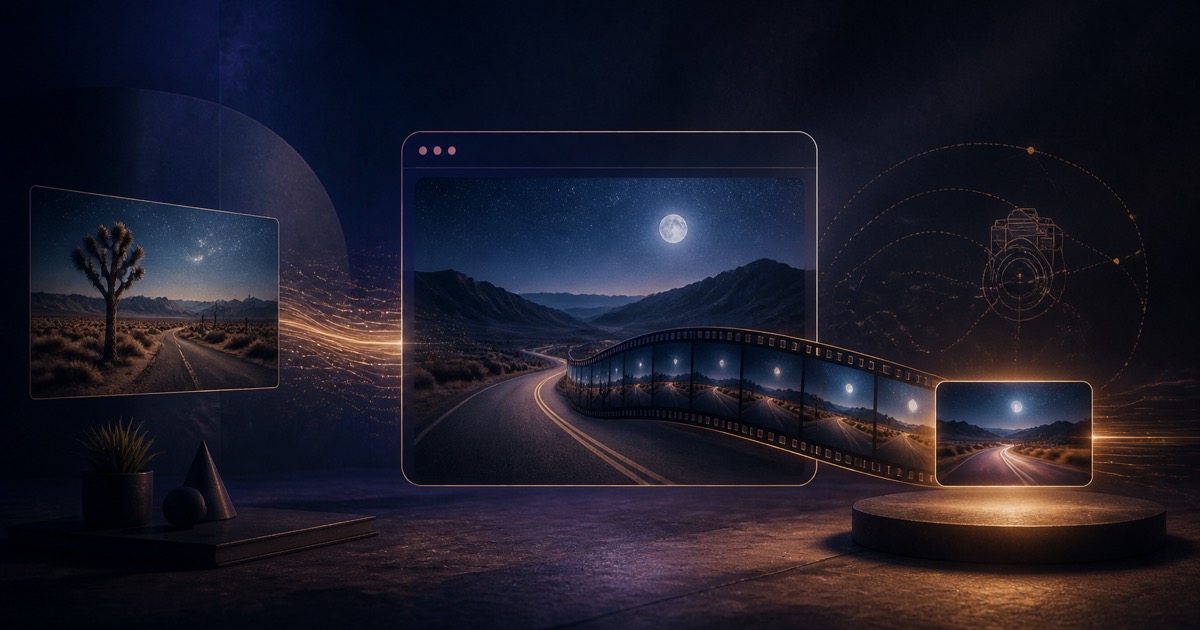
The simpler idea → image → video loop
Higgsfield is useful precisely because it gives creators a lot of room: many models, camera directions, identity tools, and production surfaces. But not every idea needs a production suite. Sometimes the job is simply to describe a scene, make a still, and see it move without translating the brief across several tools.
That is the Wurt.app angle. Picwurt is the starting point for a still or an edit; Vidwurt carries that image into a short image-to-video or text-to-video pass. A focused loop means fewer decisions before the first draft, a visible handoff between the frame and the motion, and a browser workflow you can understand without learning a whole campaign system.
“Creative freedom” here has a specific meaning: your prompt's intent stays visible instead of being silently reframed by a separate prompt-polishing layer, and you can choose how much help to add with High Fidelity where that control is available. It does not mean every request is accepted, that every model behaves identically, or that Wurt removes its terms and safety boundaries. Use media you own or have permission to use, and judge the result on the actual model and settings you selected.
For a creator who wants to explore a character, mood, or camera idea quickly, that small loop may be the better fit. For a team building a reusable production pipeline, Higgsfield's larger surface may be exactly the point.
What Higgsfield AI does now
Higgsfield is not only an image-to-video button. Its current AI video workspace presents multiple models in one place and describes text-to-video, image references, first-and-last-frame references, motion control, and editing of existing video. The live model list and output behavior are changeable, but the page currently names options including Seedance 2.0, Kling 3.0, Wan 2.7, Sora 2, and Veo 3.1. Treat that list as a snapshot reviewed August 28, 2026—not a permanent promise.
The cinematic side is a real differentiator. Higgsfield's Camera Controls page lists more than 50 named motion presets, including crane, dolly, orbit, focus-change, handheld, and whip-pan styles. Its current Cinema Studio help guide also documents a more deliberate camera-and-lens workflow. If your prompt is really a shot list, a camera move, or a multi-shot sequence, this depth may be the point of staying.
Higgsfield also has dedicated image and identity paths. The Soul help guide describes Soul, Soul 2.0, and Soul Cinema, with presets, Moodboards, Soul HEX, reference images, and model-specific Soul ID characters. That is materially different from a lightweight image-to-video handoff: it is a workflow for shaping a visual identity and reusing a character across the relevant model family.
For teams and commercial work, Canvas is a node-based board for chaining prompts, references, and generations. Higgsfield's Canvas help documentation describes saved workflow templates, parallel model comparisons, and live collaboration. Its Marketing Studio and Supercomputer pages cover URL-to-ad workflows, campaign variations, connected apps, and agentic automation. Wurt.app does not try to replace those surfaces.
Independence: Wurt.app is independent and not affiliated with Higgsfield, Inc. Product names, plan terms, model access, and credit costs can change; use the linked Higgsfield pages and account UI as the current authority.
Credits, plans, and expiry: the practical difference
The biggest switching question may be billing shape rather than image quality. Higgsfield's plan guide says the free tier supports limited generation without credits, while paid plans add a broader model library, monthly credits, and other capabilities. On individual plans, those subscription credits reset at each billing cycle and do not roll over. The current pricing page is the place to check the live tiers and allowances.
Top-ups have a separate rule. Higgsfield's Credit Pack guide describes a one-time purchase that does not change the plan or auto-renew, but says those credits are valid for 90 days from purchase and require an active subscription to use. The broader credit guide says subscription credits are spent first, then other balances are used by expiration date. It also says credit costs are shown before a generation is confirmed.
Wurt.app has a different intended shape for occasional work: paid credits are used when you create and do not reset as a monthly subscription allowance. That can be easier to reason about for a creator who generates in bursts, but it does not make every render free or guarantee a lower total bill. Credit costs, model availability, and account terms still apply. The live Wurt interface is the authority before you submit a run.
So the honest tradeoff is simple: Higgsfield's subscription can bundle model access, monthly capacity, concurrency, and selected Unlimited or free-generation benefits, while Wurt.app keeps the entry decision narrower and pay-as-you-go. If you generate enough to use a plan's included models and collaboration features, Higgsfield's structure may be exactly what you want.
Wurt.app vs. Higgsfield AI: the practical comparison
The table separates documented product scope from workflow fit. It is not a quality benchmark, and no single model or plan represents every generation on either service.
| Question | Wurt.app | Higgsfield AI |
|---|---|---|
| Core path | Browser-based Picwurt stills and edits, with a direct handoff to Vidwurt for text-to-video or image-to-video. | A broad creative workspace covering image, video, editing, camera workflows, model selection, and specialist tools. |
| Billing shape | Pay-as-you-go credits for paid creation; paid credits are not a recurring monthly allowance. Eligibility for any starting offer can vary. | Free limited access plus individual and business plans. Subscription credits reset at renewal; current help documentation says Credit Packs expire after 90 days and require an active subscription. |
| Model breadth | A smaller current set of Picwurt and Vidwurt choices shown in the Wurt interface; choose by the task and visible cost. | Multiple current image and video models in one platform, with model access and included features depending on plan and live availability. |
| Camera and motion control | Prompt-directed motion and the controls exposed by the selected Vidwurt path; it is designed for a short still-to-motion handoff. | Named cinematic camera presets, reference-video motion control, first/last frame options, and Cinema Studio for more elaborate shot direction. |
| Identity and image work | Start from a prompt or uploaded image in Picwurt, with optional High Fidelity enhancement where the control is available, then animate the still. | Soul family tools, Moodboards, Soul HEX, reference images, and model-specific Soul ID characters; the workflow is deeper but has more concepts to learn. |
| Canvas, teams, and automation | One focused browser session for a still and a clip; it is not a node graph, shared campaign board, or connected-app automation suite. | Canvas supports connected generation nodes and collaboration; Marketing Studio, business workspaces, Supercomputer, and official integrations cover broader production workflows. |
| Prompt workflow | Wurt publishes a prompt-fidelity approach: the prompt's intent stays visible, and High Fidelity is an optional enhancement where available. Terms and safety boundaries still apply. | Higgsfield's own model, tool, and plan behavior governs the request. Specialized tools can add controls and references beyond a single prompt. |
| Best reason to choose it | You want a small browser workflow for a still → motion experiment, with pay-as-you-go paid credits and no need to adopt a full production suite. | You need model variety, cinematic presets, identity tools, a node-based board, or marketing/team/automation features in one account. |
One important correction: “Higgsfield alternative” does not automatically mean “a simpler Higgsfield clone.” Higgsfield's current product surface includes camera direction, identity, Canvas, campaign tools, and model routing. Wurt.app is a narrower alternative for a different job, not a one-for-one replacement.
Who should switch—and who should stay
Search intent usually starts with a specific pain: an expiring balance, a monthly plan that does not match an irregular schedule, a desire for a simple image-to-video flow, or a prompt that did not produce the intended structure. That pain can point toward Wurt.app, but it can also mean you need a different Higgsfield plan or tool. Use the decision below as a workflow check, not a verdict on output quality.
Stay with Higgsfield if…
- You need to compare several leading models without maintaining separate accounts or API setups.
- Camera presets, Cinema Studio, first/last frames, motion references, or shot planning are central to the project.
- You rely on Soul ID or a reusable identity workflow for characters, fashion, or editorial images.
- Your team needs Canvas, shared assets, Marketing Studio, business controls, or connected-app automation.
- A monthly allowance, paid concurrency, or included model access matches the volume you actually generate.
Try Wurt.app if…
- You want to open a browser, make one strong still, and turn it into a short clip without learning a larger suite.
- Pay-as-you-go paid credits fit occasional or bursty projects better than a recurring monthly allowance.
- You care about keeping prompt intent legible and choosing a current video path from one Wurt session.
- You do not need a node graph, campaign generator, reusable Soul character, or multi-person production board.
- You are willing to judge the selected model's result and visible credit cost on your own prompt.
How to move an image-to-video workflow to Wurt.app
Do not try to copy Higgsfield's entire tool vocabulary into a smaller product. Copy the creative job: establish the frame, describe the motion, check the cost, and iterate with the least expensive useful pass.
- Open Wurt.app in a browser. Sign in when you are ready to create. Any starting-credit eligibility is account- and path-dependent, so treat the live signup flow—not this article—as the authority.
- Make or upload the starting frame in Picwurt. Use text-to-image or upload an image you own or have permission to edit. Link the visual identity, subject, lighting, and composition you need before you ask for motion.
- Hand the still to Vidwurt. Use the image-to-video path when the frame matters, or use text-to-video when you want the video model to construct the scene. The current model names, durations, audio behavior, and limits are shown in the interface.
- Write motion as an ordered change. State who or what moves, what stays fixed, the camera direction, the pace, and the ending state. For example: “the subject turns toward the window, the camera makes a slow arc right, the background stays still, and the clip ends on the profile.”
- Use High Fidelity when it is available and useful. Wurt's prompt-fidelity approach is about preserving the request's intent; High Fidelity is an optional aid where the control is exposed. It is not a promise that every model will interpret every phrase identically.
- Review before spending. Check the selected model, duration, aspect ratio, audio behavior, watermark choice, and visible credit cost. A short draft can answer the motion question before you commit to a more involved pass.
That workflow can complement Higgsfield rather than replace it. You might use Wurt.app to test a direct still-to-motion idea, then return to Higgsfield for camera presets, a Soul identity, Canvas branching, or a campaign workflow that the smaller path does not provide. For more help with ordered motion, see Wurt's AI video prompt guide.
Wurt.app's limitations
Wurt.app is deliberately narrower. It does not offer a one-for-one version of Higgsfield's deep model catalog, Cinema Studio, named camera-move library, Soul ID training, Canvas graph, shared business workspace, Marketing Studio, or Supercomputer connectors. If one of those is the reason you are evaluating Higgsfield, staying there is likely the more direct choice.
Wurt's current model choices, output options, credit costs, and availability can also change. A pay-as-you-go workflow is easier to budget for occasional use only if you read the cost shown before each run and keep an eye on the balance. It is not an unlimited plan, a guaranteed free-credit offer, or a guarantee of faster or higher-quality results.
Finally, prompt fidelity is not the same as unrestricted output. Wurt terms and safety boundaries still apply, and you should upload only media you own or have permission to use. The product is a second path for a specific creative job—not a promise that every request will render exactly as imagined.
If you are also comparing other video workflows, the Runway alternative guide and Sora alternative guide cover different tradeoffs. They are adjacent decisions, not a claim that one generator wins every prompt.
Frequently asked questions
Can you use Higgsfield AI without a subscription?
Higgsfield's current plan guide says you can generate without a paid plan, but access is limited to a small set of models and does not include credits. A subscription unlocks the full model library, credit allowances, and other plan features. Exact access can change, so check the live pricing page.
Do Higgsfield AI credits expire?
According to Higgsfield's current credit documentation, subscription credits reset at each billing cycle and unused credits do not roll over. The Credit Pack guide says one-time pack credits are valid for 90 days from purchase and require an active subscription to use. Terms are changeable; confirm the current rules in your account.
Does Higgsfield AI have cinematic camera controls?
Yes. Higgsfield's Camera Controls page currently lists more than 50 cinematic motion presets, and its video pages describe additional reference and Cinema Studio controls. The names, availability, and plan access can change, but camera direction is one of Higgsfield's defining strengths.
What is a practical Higgsfield AI alternative?
It depends on the workflow. Higgsfield is a strong fit for model breadth, cinematic presets, Soul identity tools, Canvas, marketing, collaboration, and automation. Try Wurt.app if you want a smaller browser workflow for Picwurt stills and Vidwurt image-to-video with pay-as-you-go paid credits and a prompt-fidelity approach. Neither service is objectively right for every creator.
Does Wurt.app require an active subscription?
Wurt.app uses pay-as-you-go credits rather than requiring an active monthly subscription for paid usage. Eligible accounts may see a starting offer, but free credits are not promised and should not be assumed for a project. Check the live signup and purchase flow for the current terms.
How do I move an image-to-video project from Higgsfield to Wurt.app?
Start with an image you own or have permission to use. Make or upload the still in Picwurt, then use the image-to-video path in Vidwurt. Describe ordered motion and camera direction, choose the current model and duration, and review the visible credit cost and audio behavior before generating.
Sources and update notes
Product, plan, and credit facts about Higgsfield were checked against first-party pages on August 28, 2026. Prices, model menus, plan allowances, free-generation rules, credit costs, and expiry terms are volatile; the live source pages and account UI take precedence. No hands-on benchmark or fabricated output test is implied.
- Plans and credits: Higgsfield pricing, plan guide, how credits work, and Credit Pack guide.
- Video and camera: AI video workspace, Camera Controls, and Cinema Studio help.
- Image and identity: Soul 2.0 overview and Soul help guide.
- Canvas, marketing, and automation: Canvas overview, Canvas help guide, Marketing Studio, Supercomputer help, and external integrations.